
The City of Colorado Springs completed a comprehensive update of the Zoning and Subdivision Ordinance, Chapter 7 of the City Code, in June of 2023. The goal of this undertaking, which was called RetoolCOS, was to establish a new, modern and more user-friendly Unified Development Code (UDC) for land development within Colorado Springs. Since the adoption of the new UDC, City staff and others have identified errors, conflicts, oversights, and other concerns that require changes. After creating a list of necessary updates, the Planning Department has proposed a three-phase process to update the UDC through a project titled, the UDC Scrub.
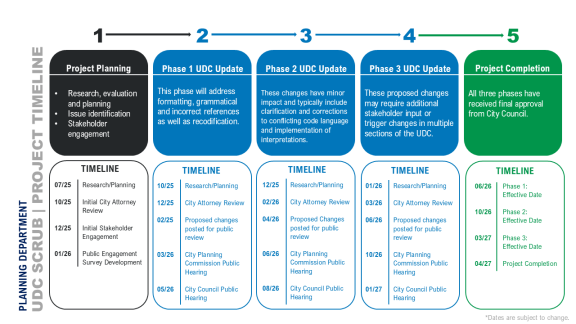
- Phase 1: This phase will address formatting, grammatical and incorrect references as well as recodification.
- Phase 2: These changes have minor impact and typically include clarification, corrections to conflicting code language, and implementation of interpretations.
- Phase 3: These proposed changes may require additional stakeholder input or trigger changes in multiple sections of the UDC.
What is a "code scrub?"
A "code scrub" is a general term that describes the process of assessing and updating a municipality’s zoning and subdivision ordinance for the purpose of addressing errors, oversights, and other minor concerns, but is not intended to be comprehensive. Typically, code scrubs or comparable processes occur one or more years after a comprehensive rewrite to the municipality’s zoning and subdivision ordinance. A code scrub can be thought of as a software update, where a "Version 1.2" comes out after the initial release and addresses bugs and minor issues.
About
The comprehensive update of the Colorado Springs Unified Development Code (UDC), through the RetoolCOS project was intended to address inconsistencies in the prior UDC’s text, improve the code’s useability, and modernize zoning regulations to support development that is consistent with community goals and desires. While this end was largely achieved, certain inconsistencies have been identified in the current UDC. In addition, various provisions have been identified as needing to be reassessed.
The City Planning Department has been carefully tracking each of these concerns, and has categorized them into three categories, all of which will be addressed through a UDC Scrub process that has three phases:
- The first phase includes all minor errors throughout the UDC such as typographic or grammatical issues.
- The second phase includes errors that are consequential to the code section they are located within only, and do not have larger impacts to the broader code.
- Finally, phase three issues affect the UDC more broadly and have implications that can result in significant changes, typically touching more than one section of the code.
Opportunities for community and stakeholder engagement are embedded throughout the UDC Scrub phases; designed to capture general feedback, user experience, as well as specific concerns related to the proposed updates within each of the phases.
Project Timeline
Get Involved
The UDC Scrub includes numerous opportunities for public and stakeholder engagement aimed at capturing community opinions and thoughtful ideas throughout each of the key project phases. City Planning looks forward to hearing your ideas and insights as we complete this important process.
As we begin preparing updates for public hearings, residents, stakeholders, and members of the public may contribute their thoughts and ideas using the online comment card linked with each of the phased descriptions outlined below:
Project Planning & Phase 1
Phase 1 of the UDC Scrub includes updates that address formatting, grammatical and incorrect references, as well as recodification. Members of the public may consider reviewing the Table of Proposed Changes below and fill out the comment card to provide general project feedback and concerns specific to changes proposed within the scope of Phase 1.
Phase 2
Phase 2 of the UDC Scrub includes changes that have minor impact and typically include clarification, corrections to conflicting code language, and implementation of interpretations.
- Table of Proposed Changes (to be released in February of 2026)
- Comment Card – Phase 2 (coming soon)
Phase 3
Phase 3 of the UDC Scrub proposes changes that may require additional stakeholder input or trigger changes in multiple sections of the UDC.
- Table of Proposed Changes (to be released in March of 2026)
- Comment Card – Phase 3 (coming soon)