Project Updates
January 2026 Preliminary Engineering Update
The project team has received comments from BNSF and UPRR on the resubmitted 10% rail plans. The purpose of this resubmittal is to address significant comments from the railroads from previous plan submittals. Once a design option is approved by the railroads, the project will proceed to complete the environmental review process as required by the National Environmental Policy Act (NEPA).
SDRUR’s approved Purpose and Need includes improvements to multimodal connectivity, access, and safety. The project includes a grade separated crossing of the railroad tracks by the Shooks Run trail. This important crossing would complete the Legacy Loop trail network. This trail crossing is complex and constrained by railroad, stormwater, and other requirements. There are currently three technical solutions that are currently under consideration with the railroads including one bridge option and two underpass options. All design options meet the requirements of the grant. Additional information will be provided once final approval is received.
In late 2024 and early 2025, The Federal Railroad Administration (FRA) and other federal agencies experienced some disruptions from new guidance and policies related to the NEPA process, which impacted the SDRUR project timeline. The City of Colorado Springs has completed most technical evaluations, with historical resources consultation with the Colorado State Historic Preservation Office still ongoing and is nearing the completion of the environmental action. FRA has shared with the City of Colorado Springs that the project is being processed as a Categorical Exclusion. For more information about the FRA’s Categorical Exclusion process, please visit the FRA website.
In late 2025, the FRA requested that the NEPA process for the SDRUR project be paused while the Shooks Run trail connection structure alternatives are confirmed with UPRR and BNSF. This is a typical approach to ensuring an efficient finalization of the environmental clearance documentation for highly technical solutions when the project impacts vary depending on the alternative chosen.
Overview
Updated January 2026
The Colorado Springs South Downtown Rail Underpass Reconstruction project (SDRUR) looks to address safety and operational issues along the rail corridor and improve transportation connectivity for all travel modes to downtown Colorado Springs.
Improvements under the project scope include:
- Replacing three railroad bridges at Nevada Avenue, Tejon Street, and Shooks Run
- Replacing the Las Vegas Street Roadway over Shooks Run bridge
- Improving Tejon Street and Nevada Avenue from Fountain Boulevard to Mill Street
- Improving other neighborhood streets and sidewalks
- Creating quiet zones and improving pedestrian access at Sierra Madre Street and Las Animas Street
- Planning for future connection of the Legacy Loop trail
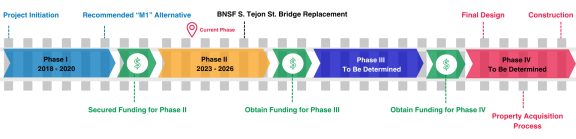
The project currently has four phases, each phase building upon the last one:
- Phase I (2018 – 2020) – Alternatives Evaluation
- Phase II (2023 – 2026) – Preliminary Engineering & Environmental Review
- Phase III (TBD) – Interim Projects
- Phase IV (TBD) – Final Design & Construction
About
The Pikes Peak Rural Transit Authority (PPRTA) funded the initial phase (Phase I: Alternatives Evaluation), which studied all options and recommended a preferred alternative (previously known as the M1 alternative). This phase included engagement with adjacent property owners, business owners, stakeholders, the public, and the Union Pacific and BNSF railroads. For more information on the previous studies’ engagement efforts, you can read the Phase I Alternative Evaluation Report.
While conducting their analysis, multiple options were considered. The decision to move forward with the preferred alternative (previously known as the “M1 Alternative”) was due to it being the most cost-effective and lowest impact option.
In the project’s current phase (Phase II: Preliminary Engineering & Environmental Review), the City is advancing the conclusions from the alternatives evaluation to develop the preliminary design and secure an environmental clearance. Preliminary design will not provide enough information to understand the impacts on properties, and any required property acquisition will begin in future phases. The environmental clearance process will evaluate the preferred alternative recommended in Phase I and a no-build alternative.
During Phase III, the City will consider several alternatives to improve the South Downtown area until the proposed project, SDRUR, can move into Phase IV. During this time, and in coordination with the railroads, the City will explore options to mitigate noise, reconnect the community, and improve multimodal safety.
Phase III will also be influenced by the BNSF’s proposed schedule to replace the South Tejon Railroad bridge in its current location. The BNSF railroad bridge replacement is separate from the City’s SDRUR project, but the City of Colorado Springs will continue to provide the latest information made available.
BNSF plans to start construction of the existing rail bridge over Tejon St. in its current location between now and mid 2026. On December 15 2024, the Public Utilities Commission (PUC) approved the BNSF’s original schedule, which proposed having construction begin in April 2024 with completion by October 2024. As of January 2026, construction has not begun, due to a utility conflict issue that will be resolved prior to construction start date.
Additional details from the PUC are included below:
- The proposed replacement bridge is a 111-ft, 3-span, prestressed concrete box beam bridge.
- The railroad track's horizontal and vertical location will not change.
- The replacement bridge will increase the vertical clearance above Tejon St. from 13'-2-1/2" to 14'-10-1/2".
- The existing bridge columns and supports will be removed and new columns will be constructed.
- BNSF is paying for 100 percent of the cost of the project.
Because this project is being administered and managed by BNSF, this information may be subject to change. The City will provide additional information as it becomes available. The SDRUR project is expected to continue because constructing a new bridge in its existing location does not satisfy the project’s Purpose and Need in its entirety. The new bridge will be an improvement to existing conditions and will raise the vertical clearance beneath the new bridge but will still not satisfy the 16.5’ minimum vertical clearance required by the railroad design guidelines.
Project Funding
The project's current phase is federally funded through a fiscal year (FY) 2021 federal grant. The $3.8 million grant ($2.5 million from federal funding) will fund the preliminary engineering and environmental clearance for the project. The FY21 federal grant does not fund final design, property acquisition, or construction.
Each year the Federal Railroad Administration (FRA) releases funding for specific railroad safety improvement projects. For Fiscal Year 2022, FRA received a record number of applicants for their Consolidated Rail Infrastructure and Safety Improvements (CRISI) grant, and they were only able to award 30% of the project applicants.
The City of Colorado Springs learned in September 2023 that SDRUR was not selected for the FY2022 CRISI grant funding.
Contingent to BNSF replacing the Tejon St bridge at its current location, the City will not pursue additional federal funding that would realign the rail line resulting in property impacts, until the ongoing National Environmental Policy Act (NEPA) process is completed. The NEPA process is expected to be completed in 2026. This would not preclude the City from seeking additional federal or other funding opportunities for other SDRUR project elements (i.e. Phase III Interim Projects) not related to rail realignment resulting in property impacts.
Property Process
The South Downtown Rail Underpass Reconstruction (SDRUR) project is partially funded by federal government dollars. Government projects such as the SDRUR, designed to benefit the public, can result in acquisition of private property, and sometimes in the displacement of people from their homes or businesses.
Congress passed the Uniform Act in 1970 to ensure that private property owners and tenants are treated fairly and equitably and receive the appropriate levels of protections and assistance when displaced by federal projects. The City’s Real Estate Manual and acquisition processes comply with Uniform Act Requirements. The City’s Real Estate Manual outlines objectives for the City’s Real Estate Services, including:
- Ensuring the City conducts its acquisition activities in a manner that minimizes hardships to property owners, tenants and the City.
- Ensuring the City handles all real property acquisitions fairly and consistently.
For more information about the implementation of the Uniform Act for displaced individuals, please review the City’s Real Estate Manual’s Chapter 4 (Acquiring Real Property) and Chapter 9 (Valuing Real Property Interests). Just Compensation and the requirements of the City Real Estate Manual and Uniform Act apply to current and future property owners Specific questions related to City’s relocation procedure can be directed toward Kellie Billingsley at Kellie.Billingsley@coloradosprings.gov.
Public Involvement
Public Engagement
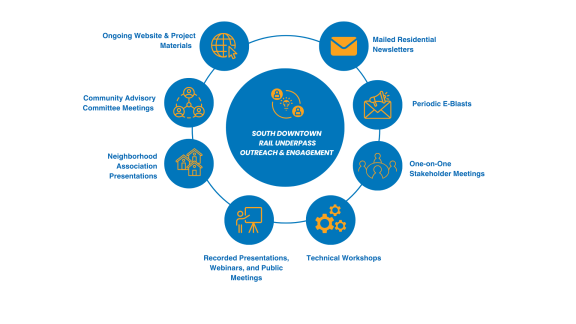
The City is committed to a robust and transparent public engagement process. The project team plans to continue disseminating regular updates to the broader community through the project website, newsletters, the Community Advisory Committee, public webinars and stakeholder meetings, and other forms of project materials (digital and print). The second phase of the SDRUR project must also adhere to the National Environmental Policy Act (NEPA) framework for outreach and engagement.
Sign up for project updates, notifications, and invitations to upcoming meetings, including opportunities to provide input on the current planning and design effort here.
Engagement to Date (last updated January 2026):
During Phase II: Preliminary Engineering and Environmental Clearance, the City has held the following engagement activities so far:
- 400 mailed project newsletters
- 600 subscribers received monthly e-blasts
- 13 one-on-one meetings or discussions with property owners, community organizations, and local businesses
- 5 stakeholder committee meetings
- 4 Mill Street Neighborhood Association Meetings (October 2023, February 2024, April 2024, October 2025)
- 1 recorded presentation
- 4 Community Office Hours
September 2024: Community Office Hours
In early fall 2024, the City of Colorado Springs hosted virtual and in-person Community Office Hours sessions for the public to learn more about SDRUR and ask questions directly to the project team. A virtual session was held via Zoom on Tuesday, September 24, and three in-person sessions were held on Wednesday, September 25, at The Independence Center in Downtown Colorado Springs. The feedback provided informed an updated project FAQ which is available on the “Project Materials” tab. A summary of the discussion can be viewed here.
December 2023: South Downtown Rail Underpass Reconstruction Recorded Presentation #1
This presentation replaced the Virtual Public Meeting originally scheduled for Thursday, December 7, 2023. The video overviews the project’s history, phases, and next steps. If you have any questions after watching the recorded presentation, we encourage you to contact the project team by emailing info@SDRUR.com or calling the project hotline at 719-301-3306.
Community Advisory Committee
The SDRUR Community Advisory Committee (CAC) will serve as a sounding board for the project team, a source of collaboration on specific project elements, and a vital bridge between community members and the project team.
The CAC will convene throughout the project to share updates and foster the transparency of project decision-making.
CAC Meeting Summaries
- Meeting # 1 Summary – June 28, 2023
- Meeting #2 Summary - October 19, 2023
- Meeting #3 Summary - March 7, 2024
- Meeting #4 Summary - August 28, 2024
- Meeting #5 Summary – September 26, 2025
CAC Roster
The CAC is made up of community leaders representing different interests related to the SDRUR project. Please reference the roster for a full list of CAC members and their affiliated organizations.
| First Name | Last Name | Organization |
|---|---|---|
| Jerry | White | Bike Colorado Springs |
| Brady | Williams | Colorado Springs City Council, District 3 |
| Devin | Camacho | Colorado Springs Chamber & Economic Development Corporation |
| Steven | Smith | Colorado Springs Fire Department |
| Chad | Wright | Colorado Springs Housing Authority |
| Tish | Olszewski | Colorado Springs Police Department |
| Sara | Vaas | CONO |
| Chelsea | Gondeck | Downtown Partnership |
| Gary | Feffer | Fountain Colony Real Estate |
| Josh | Gainey | Hillside Community Center |
| William | Boddington | Historic Preservation Alliance of Colorado Springs |
| Paul | Spotts | The Independence Center |
| Jennifer | Cecil | Mill Street Neighborhood Association |
| Tim | Seibert | Norwood Development |
| Terry | Anderson | Springs Rescue Mission |
| Jody | Barker | Pikes Peak Area Council of Governments – Area Agency on Aging |
| Jim | Godfrey | Pikes Peak Rural Transportation Authority |
| Cindy | Aubrey | Pikes Peak United Way |
| Allen | Beauchamp | Trails & Open Space Coalition |
| Pam | Shockley-Zalabak | U.S. Olympic & Paralympic Museum |
Project Materials
Informational Materials
- Project Maps
- South Downtown Rail Underpass Reconstruction Fact Sheet
- Reconstrucción de South Downtown Railroad Hoja informativa del Proyect
- Frequently Asked Questions (updated November 2024)
Newsletters
Phase I: Alternatives Evaluation
The first phase of the project’s objective was to study and screen alternatives. The robust three-year alternatives analysis phase resulted in the recommended “M1” alternative. Throughout the first phase, the project incorporated stakeholder and community input.
The preferred alternative would:
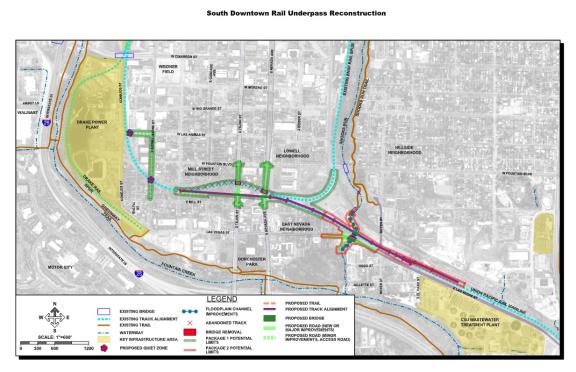
- Shift the rail alignment slightly to the south and eliminate curves in the existing alignment between Sierra Madre Street and Weber Street
- Locate the Nevada Avenue and Tejon Street railroad bridges on the new alignment.
- Rebuild a new rail bridge over the Shooks Run waterway.
- Improve at-grade crossings at Sierra Madre Street and Las Animas Street to meet quiet zone crossing requirements and address safety and noise concerns.
- Improve sidewalks on Sierra Madre Street between Mill Street and Las Animas Street, and on Las Animas Street between Conejos Street and Sierra Madre Street.
- Modify the railroad alignment to resolve clearance concerns on Nevada Avenue and Tejon Street. The scope of roadway reconstruction will span from Mill Street to Fountain Boulevard
- Allow new rail bridges to accommodate wider roadway sections at Tejon Street and Nevada Avenue
- Improve sidewalks along Nevada Avenue and Tejon Street between Mill Street and Fountain Boulevard
- If needed, rebuild short portions of the cross streets north and south of the existing railroad underpasses.
- Replace the existing rail bridge over the Shooks Run waterway and widen the existing channel to facilitate connection of the Shooks Run trail with the Legacy Loop trail (as defined in the Envision Shooks Run Facilities Master Plan).
- Improve water quality in the Shooks Run and Fountain Creek floodplain.
- Replace the Las Vegas St bridge over Shooks Run for the trail connection.
The following documents contain additional information related to the planning process to date:
Previous planning identified the preferred alternative of M1. M1 impacts surrounding property the least and results in the lowest cost estimate of the numerous alternatives considered. M1 also meets all project goals including connecting the Shooks Run community to the Legacy Loop trail and creating neighborhood quiet zones.
The following documents contain additional information related to the planning process to date:
Alternative Evaluation Report
Project Documents
- May 2020 Newsletter
- October 2020 Newsletter
- November 2020 Newsletter
- December 2020 Newsletter
- February 2021 Newsletter
Presentation Documents
Frequently Asked Questions
Public Meetings
November 19, 2020 Public Meeting
A Digital Public Information Meeting for the South Downtown Rail Underpass project took place Nov. 19, 2020. Citizens were able to participate online through computer and by phone and provide opportunities to ask questions.
Preferred Alternative Map